
Why building a resilient economy requires us to look beyond carbon, rethink what we value, and change how investment decisions are made.
We are becoming increasingly sophisticated at measuring carbon emissions, modeling climate risks and financing low-carbon technologies. Yet we remain remarkably poor at understanding the wider consequences of our decisions. What if, in solving one crisis, we are inadvertently contributing to another?
A renewable energy project might reduce emissions while putting pressure on scarce water resources. A bioenergy investment might deliver climate benefits while competing with food production or damaging biodiversity. An infrastructure project might strengthen energy security while undermining local livelihoods. These are not hypothetical concerns. The Intergovernmental Panel on Climate Change (IPCC) has warned that poorly designed land-based climate solutions can create significant trade-offs for biodiversity, water availability, food security and human well-being. We risk making progress against climate change while continuing to erode the natural and social systems on which our economies depend.
We risk making progress against climate change while continuing to erode the natural and social systems on which our economies depend. Reflections from Building Bridges 2026.
Resilience is the new language of finance
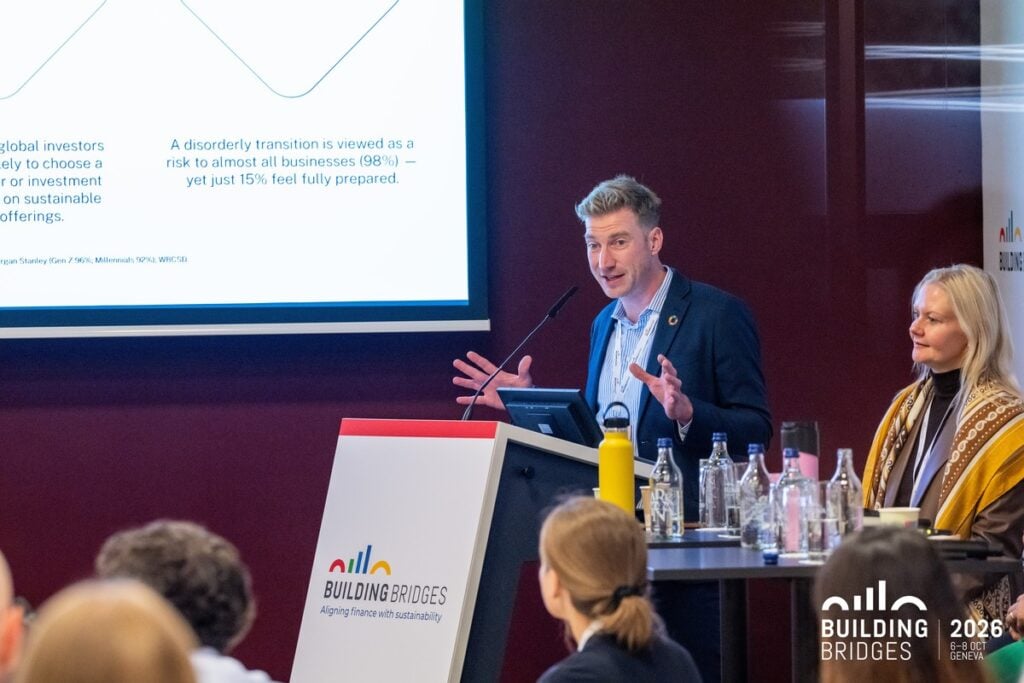
This tension was particularly striking at Building Bridges 2026 in Geneva. Across discussions with investors, insurers, businesses and policymakers, resilience emerged as a defining theme. The conversation is shifting from managing sustainability risks towards protecting long-term value in an increasingly unpredictable world. And the risks are becoming harder to ignore. According to the European Insurance and Occupational Pensions Authority (EIOPA), historically only around a quarter of Europe’s economic losses from extreme weather and climate-related events have been insured.
Meanwhile, the UN Environment Programme’s Adaptation Gap Report 2025 estimates that developing countries will need between $310 billion and $365 billion annually for climate adaptation by 2035. International public adaptation finance amounted to just $26 billion in 2023.The financial case for resilience is becoming clearer. Yet the investment response remains fragmented. At Building Bridges, pension funds and insurers were repeatedly identified as potential drivers of change. But there were fewer concrete examples of how capital is being redirected towards building resilience across the wider economy.
Perhaps part of the problem is that we are still measuring too narrow a definition of value.
What happens when we change the information?
At Building Bridges, Capitals Coalition and the Value Balancing Alliance challenged participants to consider a deceptively simple question: would you make the same investment decision if you understood its full consequences for people and nature?
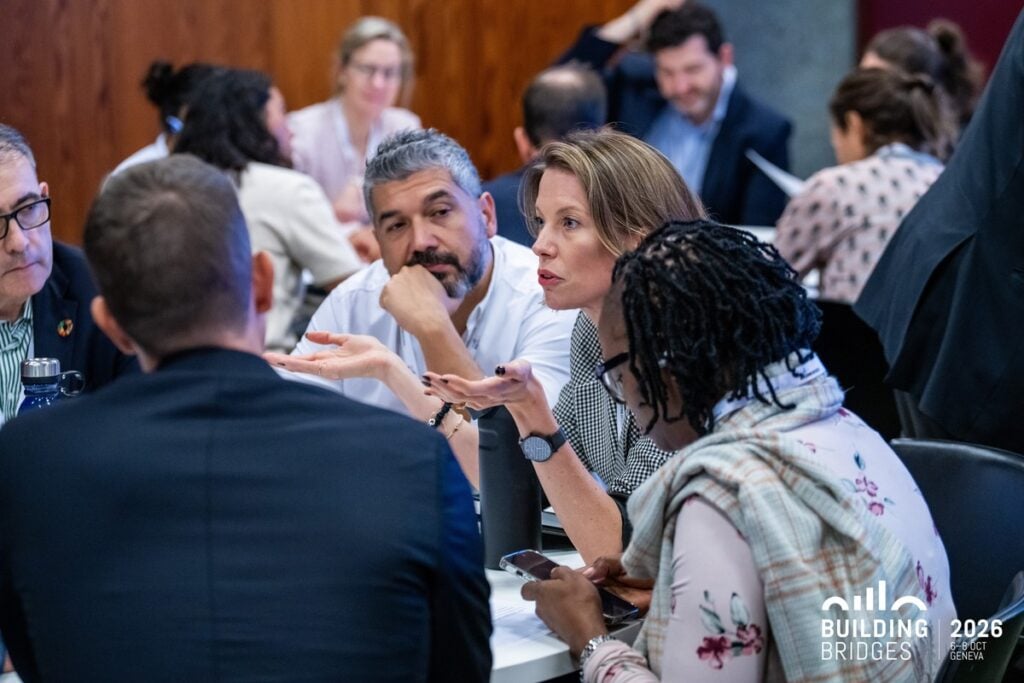
Through an interactive workshop, participants explored how investment choices could change when conventional financial and ESG information was complemented by monetary valuations of environmental and social impacts. Participants acted as investment committees assessing Plantible, an Astanor portfolio company producing an egg-white alternative from aquatic plants. Initially working with conventional ESG information, they then received an impact valuation developed with ImpactAccounting.ai. The additional information shifted their assessment of the company’s impact potential and, more importantly, it changed what they considered material: attention moved from carbon emissions to land use and whether the product genuinely displaced eggs, while the biggest perceived risk shifted towards additionality.
Interestingly, participants spent little time discussing the headline impact value. Instead, they focused on what drove that value, the underlying assumptions and trade-offs, and what investors could do to improve outcomes. The real power of impact valuation wasn’t the number itself, but the better questions and decisions it enabled.
Discussions explored the differences between traditional ESG indicators and impact valuation, while a new prototype created by Bridgewater Associates in partnership with Capitals Coalition, running on Bloomberg Terminal, generated particular excitement about bringing this information into everyday investment analysis. Two investments can offer similar financial returns and carbon reductions while delivering very different outcomes for biodiversity, human health, land use or communities. Impact valuation helps make these consequences visible and comparable, revealing trade-offs and opportunities that conventional financial analysis may overlook. When we change the information available to decision-makers, we can change the decisions they make.
Research through the VBA Financial Markets Chapter reached a related conclusion from the investor side. Asset Owner Data Preferences and Impact Valuation Methods identifies seven emerging institutional requirements and maps eight investment use cases. In the initial VBA asset-owner survey responses, interest in impact valuation coexisted with low satisfaction with existing ESG data, while provider comparisons revealed material differences in coverage, methodology and monetization. These are early signals, not representative findings for the entire asset-owner market. Asset owners need more than a single score: they need explainable methods, sufficient investment-universe coverage, appropriate portfolio aggregation and credible data quality controls. Crucially, the right dataset depends on the decision—whether strategic allocation, manager selection, portfolio analysis, risk oversight or stewardship.
Resilience requires a bigger picture
Information alone will not transform financial markets. One recurring challenge at Building Bridges was that the benefits of resilience investments are often widely distributed, while their costs fall on individual investors. Restoring a watershed, protecting biodiversity or strengthening communities can create enormous societal value. Yet much of that value may never appear in the financial returns of those funding the investment. We cannot expect private finance, operating within existing incentives, to solve this challenge alone.
The recent Impact Valuation, Externalities and Transition Finance paper by VBA adds an important dimension: environmental and social externalities may affect enterprise value as they become internalized through policy, market pricing and other financial transmission channels. The purpose is not simply to attach a monetary number to every consequence, but to identify material channels and apply transparent assumptions to valuation, risk budgeting, transition financing and investment decisions.
We need investors, businesses, policymakers and regulators working together to recognise these wider benefits, discourage harmful activities and create incentives that reward long-term value creation. This is why we are supporting Business for Nature’s call, backed by more than 130 businesses and financial institutions ahead of Biodiversity COP17, for governments to reform environmentally harmful subsidies and realign incentives to make nature-positive, resilient investments the competitive choice. This is where impact valuation, supported by credible and consistent standards, has an important role: informing investment decisions while providing evidence to shape policies and financing mechanisms that reward positive outcomes.
Climate action remains essential, but a low-carbon economy is not necessarily a resilient economy. True resilience depends on healthy ecosystems, functioning natural infrastructure, strong communities and institutions capable of navigating change. As financial markets embrace resilience, we have an opportunity to rethink not only where capital flows, but what information and incentives guide those decisions.
If we continue to measure success too narrowly, we risk making better decisions against the wrong objectives. The challenge is no longer simply to finance a lower-carbon future. It is to build an economy that restores, rather than depletes, the foundations of our collective prosperity.